
When most people think about police or law enforcement, they picture firearms. But the reality of modern policing is a lot more nuanced than that. Officers deal with a wide range of situations every single day, many of which don’t call for deadly force. That’s exactly where law enforcement less lethal weapons come in. These tools give officers options. They allow them to handle a threat, control a crowd, or subdue a suspect without necessarily taking a life.
This article breaks down the most common types of less lethal weapons used by law enforcement agencies across the United States, how each one works, and why they matter in today’s policing environment.
Before we get into the types, it’s worth clearing up some confusion. You’ll often hear the terms “non-lethal” and “less lethal” used interchangeably, but they’re not quite the same thing. The term “less lethal” is actually the more accurate one. It means that while the weapon is designed to incapacitate or deter without killing, there is still a small risk of serious injury or death depending on how it’s used, the distance, or the physical condition of the person on the receiving end.
Law enforcement agencies in the U.S. prefer the term “less lethal” for this very reason; it’s honest about the risks while still distinguishing these tools from conventional firearms.
The use of force is one of the most scrutinized areas of modern policing. According to the Bureau of Justice Statistics, U.S. law enforcement agencies respond to millions of calls for service each year. The vast majority of these encounters are resolved without any force at all. But when force is necessary, officers need tools that match the level of threat they’re facing.
That’s the core idea behind the use-of-force continuum, a framework that guides officers on when and how much force is appropriate. Law enforcement’s less lethal weapons sit in the middle of that spectrum. They’re designed for situations where verbal commands aren’t working, but lethal force would clearly be disproportionate.
Beyond that, these tools are also central to crowd control equipment deployments during protests, civil unrest, or large public events where managing large groups of people safely is the primary objective.
One of the most well-known law enforcement less lethal weapons is the conducted energy device, most commonly recognized by the brand name Taser. These devices work by sending an electrical current through the body, which causes involuntary muscle contractions and temporarily incapacitates the person. The effect lasts only a few seconds but is enough to allow officers to take control of a situation.
Tasers have been widely adopted across U.S. law enforcement since the early 2000s. A 2011 study published in the Annals of Emergency Medicine found that Taser use resulted in serious injuries in less than 0.25% of cases, making them one of the safer options in the less lethal category. That said, there have been documented cases of cardiac events in individuals with pre-existing heart conditions, which is why training on proper use is so important.
Most modern CEDs are designed with tactical shooting principles in mind; accuracy, range, and response time all factor into how effective the device is in the field.
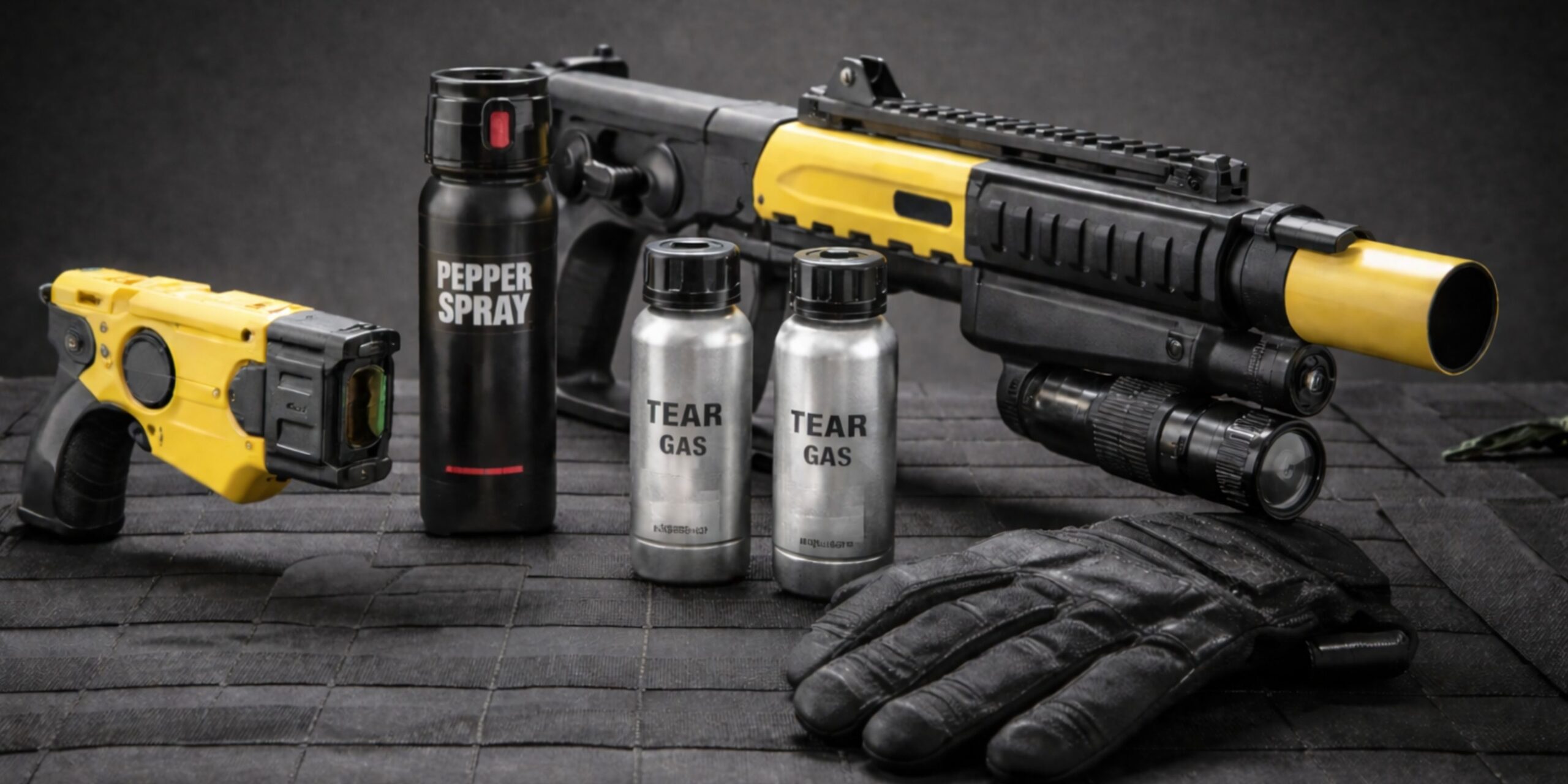
Oleoresin capsicum (OC) spray, commonly called pepper spray, is probably the most widely carried less lethal tool among law enforcement officers. It’s compact, inexpensive, and effective. When sprayed in someone’s face, OC causes immediate irritation to the eyes, nose, and throat, leading to temporary blindness and difficulty breathing.
OC spray is a staple of crowd control equipment used during protests or altercations where officers need to create distance or subdue someone resisting arrest. Different formulations exist; some are designed for individual use, while others come in larger canisters for crowd dispersal.
One thing worth noting: OC spray doesn’t work equally well on everyone. A small percentage of the population appears to have a higher tolerance to capsaicin, the active compound in pepper spray, which is why officers are trained to follow up with additional measures if needed.
When officers need to engage a threat from a distance without using live ammunition, they often turn to impact munitions, things like bean bag rounds and rubber bullets. These are typically fired from standard shotguns or dedicated less-lethal launchers and are designed to deliver a painful impact that stuns or knocks down the target.
Bean bag rounds are made of a small fabric pouch filled with lead shot. Rubber bullets, on the other hand, are exactly what they sound like, rubber or plastic projectiles fired at lower velocities than conventional rounds. Both fall under the broader category of kinetic impact projectiles.
These rounds play an important role in the firearm parts and accessories side of law enforcement equipment. Departments often maintain dedicated less-lethal shotguns, sometimes marked with bright colors like orange or yellow, specifically to avoid confusion with standard lethal firearms in high-pressure situations. The stock, barrel configuration, and magazine of these weapons are often modified to accommodate less lethal rounds and make them easy to identify at a glance.
It’s worth knowing that impact munitions are not without risk. The National Institute of Justice notes that injuries can occur when these projectiles hit sensitive areas like the head, neck, or chest, which is why officers are trained to aim for the lower body when possible.
Stun grenades, also called flashbangs, are used in tactical situations where officers need to disorient people in an enclosed space before making entry. They work by producing an extremely loud bang and a blinding flash of light. This temporarily overwhelms the senses, giving officers a brief window to gain control of the situation.
These devices are primarily used by SWAT teams and specialized tactical units rather than everyday patrol officers. They’re an important part of tactical shooting and entry procedures, particularly during hostage rescues or high-risk warrant executions.
While flashbangs are generally considered less lethal, they can cause serious burns or injuries if they detonate too close to a person. Their use is typically governed by strict departmental policies and requires specialized training.
Tear gas, more accurately referred to as lachrymatory agents, is one of the oldest forms of crowd control equipment still in use today. The most common compound is CS gas (2-chlorobenzalmalononitrile), which causes intense eye irritation, tearing, coughing, and a burning sensation on exposed skin.
Law enforcement agencies deploy tear gas in situations where large crowds need to be dispersed, and other methods haven’t been effective. It can be deployed through grenades, handheld canisters, or projectiles fired from launchers. Tear gas has been used in major crowd control operations across the U.S. and worldwide for decades.
There is an ongoing debate about the use of tear gas in dense urban environments, particularly its impact on people with respiratory conditions like asthma. The CDC classifies CS gas as a riot control agent, and while it’s generally considered safe for short-term exposure in open air, prolonged exposure can cause more serious health effects.
Water cannons are a crowd control tool more commonly seen in other countries, though they are used in the U.S. in some situations. They work by directing a high-pressure stream of water at a crowd to push people back or break up gatherings. Some departments add marking dye or chemical irritants to the water to identify participants after the fact.
Water cannons are large, vehicle-mounted systems, which limit their use to planned deployments rather than spontaneous responses. They’re less common in everyday American law enforcement but remain part of the toolkit for large-scale civil disorder situations.
Beyond individual tools, there’s also a broader category of specialty, less lethal launchers that bridge the gap between standard patrol equipment and full tactical gear. The 40mm single-shot launcher, for example, is widely used by U.S. law enforcement and can fire a variety of less lethal projectiles, including foam batons, sponge rounds, and chemical agent payloads.
These launchers are often discussed in the context of firearm parts and accessories because they share design characteristics with standard firearms; they have barrels, stocks, trigger mechanisms, and sight systems. Officers trained in tactical shooting apply many of the same principles, sight alignment, trigger control, and target identification when using these systems. The difference is that the goal is to stop a threat without permanently injuring or killing the person.
No matter how advanced law enforcement’s less lethal weapons become, they’re only as effective as the training behind them. Every major law enforcement agency in the country requires officers to complete hands-on training before they’re authorized to carry or deploy any less lethal tool. This includes understanding the appropriate distance for deployment, the physical effects on the human body, and the legal standards for when such force is justified.
The Police Executive Research Forum (PERF) has consistently emphasized that training should go beyond the mechanical use of the weapon; officers also need to understand de-escalation techniques so that less lethal tools are truly a last resort before lethal force, not a first response.
Less lethal weapons provide law enforcement with crucial options to manage threats or subdue suspects without resorting to deadly force. These tools, like Tasers and pepper spray, allow officers to de-escalate situations and gain control, significantly reducing the risk of fatalities while ensuring public and officer safety.
Tasers, or conducted energy devices (CEDs), work by delivering an electrical current that causes temporary muscle incapacitation. They are classified as “less lethal” rather than “non-lethal” because, while designed to prevent death, there’s a minor risk of serious injury, especially for individuals with pre-existing health conditions.
For crowd control and engaging threats at a distance, law enforcement uses impact munitions like bean bag rounds and rubber bullets. These are fired from specialized less lethal launchers or shotguns, designed to deliver a painful but non-penetrating blow to deter or incapacitate individuals in situations where verbal commands fail.
Tear gas (lachrymatory agents like CS gas) is an effective crowd control equipment, causing temporary eye irritation, tearing, and respiratory discomfort. While generally safe for short-term, open-air exposure, prolonged use or deployment in enclosed spaces can pose health risks, particularly for individuals with respiratory issues.
Law enforcement officers undergo extensive hands-on training for all less lethal weapons. This training covers appropriate deployment distances, understanding physiological effects, and adhering to legal use-of-force standards. It also emphasizes de-escalation techniques, ensuring these tools are used as a last resort before lethal force.
Law enforcement less lethal weapons represent one of the most important areas of modern policing equipment. They give officers real options in situations where doing nothing isn’t safe but using deadly force would be extreme. From Tasers and OC spray to bean bag rounds and tear gas, each tool has a specific role, specific limitations, and a specific context in which it performs best.
For law enforcement professionals, security personnel, and anyone interested in tactical shooting or public safety equipment, understanding how these tools work and when they’re appropriate is genuinely valuable knowledge. Whether you’re looking at crowd control equipment, exploring firearm parts and accessories for less lethal platforms, or simply trying to understand how modern policing works, the world of less lethal weapons is worth knowing well.
Disclaimer: This article is intended for informational purposes only. Always follow your agency’s use-of-force policies and applicable local, state, and federal laws when deploying any law enforcement equipment.