
If you have ever watched a group of officers train with what looks like paintball guns and wondered what is really going on, you are not alone. A lot of people mix up FX Simunition 9mm FX marking cartridges with paintball because, on the surface, both shoot a round that leaves a mark on impact. But once you look closer, these two are built for completely different jobs. One is a sport. The other is a serious training tool used by law enforcement and military units to prepare for real, high-pressure situations. In this article, we will break down what FX Simunition actually is, how it differs from paintball, and why agencies trust it for tactical training instead of recreational gear.
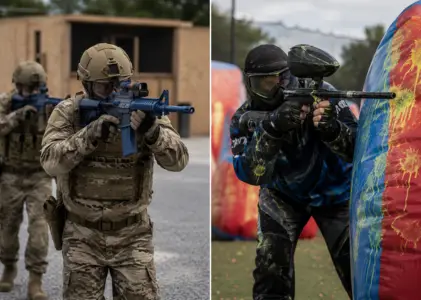
FX Simunition is a non-lethal training system built for law enforcement, military, and approved range members who need realistic, force-on-force practice. The FX marking cartridges are fired from specially modified firearms, allowing trainees to engage in realistic exercises without the risks associated with live ammunition. The cartridges leave a colored mark when they hit a target, so instructors and trainees can immediately see where a shot landed and talk through what worked and what did not.
What makes FX Simunition different from a toy or a sport device is that it is fired from the trainee’s own actual duty weapon. Simunition has developed, along with FX and Securiblank Rounds, a complete line of protective equipment and conversion kits so that a real service pistol or rifle can be safely converted to fire training rounds instead of live ammunition. This means an officer trains with the same grip, the same trigger feel, and the same muscle memory they would use on the street, just without the danger of live fire.
The Simunition 9mm FX marking cartridges are designed to mimic the recoil and feel of a real round while staying completely non-lethal. Simunition FX 9mm projectiles travel at nearly 600 fps, and the 5.56 variant reaches close to 650 fps. Inside each cartridge is a small amount of colored marking compound that bursts on impact, leaving a visible mark on the target or on a role player’s protective gear.
This combination of real recoil, real velocity, and visible feedback is what makes FX Simunition so valuable for training. The FX marking rounds, which come in six colors, are at the core of the FX Training System, known as the world’s most realistic close-range combat training system. Instructors can run a scenario, stop it, and immediately point to exactly where the round landed, which helps trainees understand their mistakes and fix them on the spot.
It is worth knowing that these rounds are not something you can just order online and use at home. Simunition products are not sold directly to civilians for personal use. The company restricts sales to authorized law enforcement agencies, military units, and certified instructors. Civilians who want hands-on experience usually need to go through a certified training course where instructors supply the rounds and oversee the session.
A simunition gun is not a separate weapon built from scratch. It is the trainee’s actual duty firearm, modified with a conversion kit so it can only fire FX training rounds. According to information shared by industry training programs, a Simunition conversion kit is a set of replacement parts for a standard-duty firearm, and these parts allow the weapon to fire special non-lethal training rounds instead of live ammunition. The kit swaps out key components inside the gun, such as the barrel, slide assembly, or bolt carrier group.
This is one of the biggest reasons FX Simunition is taken so seriously compared to paintball. A paintball marker is purpose-built from day one to be a recreational device. A simunition gun, on the other hand, starts life as a real Glock, real AR-15, or other service weapon, and is converted for training use. Once the conversion kit is installed, the firearm is designed to only chamber and fire Simunition training rounds. Live ammunition will not fit properly, which adds an important layer of safety during training exercises.
Because of this, officers train with the exact same weight, balance, and trigger pull they will use on duty. That kind of realism simply is not something a paintball gun was ever designed to deliver.
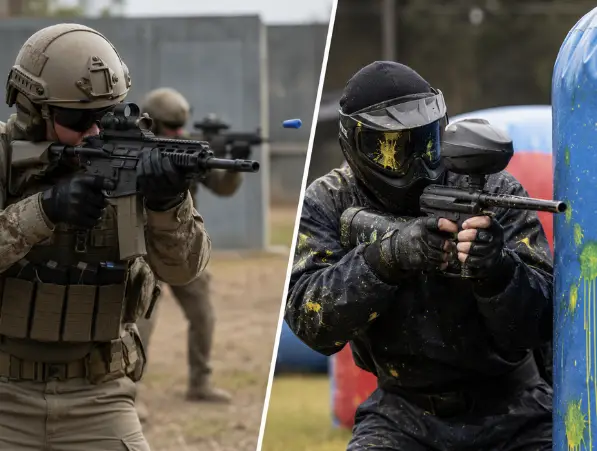
Now let’s get into the comparison everyone actually came here for. While both FX Simunition and paintball involve a projectile that marks on impact, that is pretty much where the similarities end.
Paintball markers typically fire rounds at lower velocities designed for sport play across open fields. FX Simunition rounds move much faster and are tuned specifically for close-range, real-world training distances. As mentioned earlier, Simunition FX 9mm projectiles travel at nearly 600 fps, and the 5.56 variant reaches close to 650 fps, far exceeding paintball velocities. This higher velocity at short range is intentional. It mimics how an actual threat encounter would feel, not how a weekend game would play out.
Paintball is built for recreation, competition, and fun. FX Simunition was built for something far more serious. Simunition is purpose-built for firearms training, not sport. It exists to help officers and soldiers build real decision-making skills under stress, not to score points or eliminate opponents in a game.
Paintball players use dedicated markers that were never real firearms. FX Simunition relies on the actual service weapon, converted through a kit, plus a dedicated lineup of simunition training equipment built specifically for safety during force-on-force drills. This includes things most paintball fields would never need, like specialized head protectors, throat guards, and groin protection designed to handle direct hits from a converted duty weapon at close range.
Anyone can walk into a sporting goods store and buy a paintball gun. FX Simunition is far more controlled. As noted earlier, the manufacturer limits direct sales to authorized law enforcement agencies, military units, and certified instructors. This restriction exists because the system is meant to be used inside structured, supervised training environments, not for casual or recreational use.
A common misunderstanding is that simunition training equipment is just the cartridges and the conversion kit. In reality, the full system has three core parts working together. The FX system is comprised of training rounds, weapon conversion kits, and personal protective equipment. All three pieces have to be used together for a session to be both realistic and safe.
The protective gear deserves special mention here because it is built very differently from paintball padding. Simunition developed a full line of protective equipment for both men and women, including a head protector, throat protector, and groin protector, as well as pants, gloves, a vest, and sleeves. This gear is engineered specifically to handle the type of impact these higher-velocity training rounds produce, which is a different standard than gear made for a backyard paintball match.
There is also a heavy emphasis on instructor-led training before anyone touches the equipment. The training includes instructor-level training in safe and effective staging of reality-based training using FX technologies. This is not something agencies hand out without supervision. Certified instructors run the sessions, manage safety protocols, and make sure live ammunition never enters the training area.
The short answer is realism with accountability. Paintball can be fun and even help with basic hand-eye coordination, but it was never designed to replicate a real threat encounter using a trainee’s own duty weapon. FX Simunition was built from the ground up for that exact purpose. As one industry summary puts it, allowing users to practice close-quarters combat, threat recognition, and tactical movements helps them develop essential skills under controlled but stressful conditions.
There is also a long track record behind the system. For decades, military and police officers around the world have placed their trust in Simunition to deliver realistic training. This kind of established history matters when an agency is deciding where to invest its training budget, because it shows the system has been refined and proven across thousands of real-world training sessions, not just designed for entertainment.
Cost and structure are also part of the decision. Certification courses for instructors are formally priced and scheduled, which tells you this is treated as a professional standard rather than a casual activity. Recent course listings for 2026 show tuition set at $755 for law enforcement personnel and $495 for military personnel, with sessions running over multiple days and covering everything from scenario design to safety protocols. That level of structured investment simply does not exist in the paintball world, because paintball was never meant to carry that kind of responsibility.
At first glance, FX Simunition and paintball might look like cousins because both leave a colored mark when they hit something. But once you understand how each one is built, who uses it, and why, it becomes clear they serve completely different purposes. Paintball is a sport. FX Simunition is a professional training system built around real duty weapons, certified instruction, and a level of realism that prepares officers and soldiers for situations where hesitation or poor decisions can have serious consequences. If your agency is exploring force-on-force training options, understanding this difference is the first step toward choosing equipment that actually meets your training goals.
No. While both leave a mark on impact, FX Simunition is purpose-built for professional firearms training, not recreation. It uses higher velocities, real converted duty weapons, and a much stricter safety and certification process than anything found in paintball.
Generally, no. Simunition products are sold mainly to authorized law enforcement agencies, military units, and certified instructors. Civilians who want to experience the system typically need to attend a certified training course where instructors supply and oversee the equipment.
The most common caliber is 9mm, but FX marking and non-marking rounds are also available in 5.56mm for rifles. Each caliber is designed to match the recoil and handling characteristics of the corresponding live ammunition.
Yes. Because the rounds travel at higher velocities than paintballs, dedicated simunition training equipment, such as head protectors, throat guards, groin protection, and padded clothing, is required to keep participants safe during force-on-force drills.
FX Simunition lets trainees use their actual converted duty weapon, which builds realistic muscle memory and decision-making skills under pressure. Paintball markers were never designed to replicate that level of realism, since they are built for sport rather than professional preparation.