
A school police officer spends the day in hallways, not on a highway shoulder at two in the morning. Different job, different people, different problems. So the equipment list should look different too.
It usually doesn’t. Plenty of district agencies get outfitted straight off the same catalog page as a county patrol unit, then discover halfway through the year that a third of it never comes off the shelf.
This is a big part of why less lethal weapons in law enforcement matter so much to school agencies specifically. When the people you’re protecting are mostly fourteen-year-olds, the tools that live between “talk them down” and “draw your firearm” carry almost all the weight. Get that middle ground right and most of the job takes care of itself.
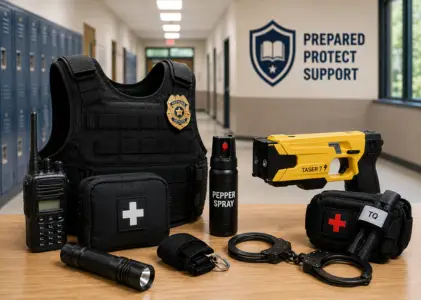
School district police are a real branch of American law enforcement, not a side project. A Bureau of Justice Statistics report published in November 2023 counted roughly 23,400 sworn school resource officers nationwide as of the 2019-20 school year, and about 4,400 of them worked directly for school district police departments rather than a city or county agency. By 2021-22, around 45 percent of public schools reported having sworn officers on campus who routinely carried a firearm, according to the National Center for Education Statistics.
State mandates have pushed those numbers up since. Texas House Bill 3 took effect September 1, 2023, and requires every campus to have at least one armed security officer present during regular school hours, absent a good cause exception. The money followed two years later. House Bill 2 in 2025 added about $430 million in school safety funding, raising the per-student allotment from $10 to $20 and the per-campus allotment from $15,000 to $33,540.
The practical result is districts standing up police departments from nothing. Hutto ISD, Leander ISD, Eanes ISD, Jarrell ISD and Liberty Hill ISD all created their own departments to meet the requirement.
Which means writing an equipment list from a blank page. That’s a rare chance to get it right instead of inheriting somebody else’s decisions.
Think about what a school officer really handles in a given month. A fight that spills out of the cafeteria. A kid in crisis who’s locked himself in a bathroom. Somebody who walked in a propped side door. A parent in the front office who won’t leave and is getting louder.
None of that is a firearm situation. All of it can go badly.
That’s the gap less than lethal weapons are built to fill. The category covers conducted energy devices, chemical spray, impact munitions and launchers. The whole idea is giving an officer a way to end something dangerous without ending it permanently.
Here’s the part agencies skip. Buying the tool is maybe twenty percent of the work. A school department needs a written use-of-force policy that specifically addresses minors, students in mental health crisis, and students with disabilities, plus documented training on every device an officer carries. A lot of districts add age thresholds or supervisor notification requirements on top. Whatever you land on, write the policy in the same conversation as the purchase order. Not six months later, and definitely not after an incident.
Worth saying plainly: people disagree about police in schools, and reasonable districts land in different spots. That disagreement is one more reason the less lethal side of your list deserves actual thought rather than a copy-paste order from the county.
NIJ has published its initial list of armor tested and found compliant with Standard 0101.07. Along with that came new names for the protection levels. Old Level II is now HG1, IIIA is now HG2, Level III is RF1, Level IV is RF3, and a new intermediate rifle level called RF2 sits between them. If your specs still say “Level IIIA,” they’re written in a language that’s going away.
Now the buying advice. A vest is only genuinely NIJ certified if it went through the full Compliance Testing Program, passed evaluation at an NIJ-approved lab, and shows up on the Compliant Products List. “NIJ tested” and “meets NIJ standards” are unregulated phrases that any manufacturer can print on a box. Look up the model number on the public list before you sign anything. Two minutes of work, and it protects your officers and your district’s legal position at the same time.
Don’t panic about what you already own. NIJ’s guidance is to keep wearing the armor you have, and the Compliance Testing Program expects to maintain the 0101.06 list through at least the end of calendar year 2029. You have runway to plan replacements instead of scrambling.
Past armor, a school officer’s daily law enforcement tactical gear should be lighter than a patrol loadout, and that’s deliberate. Radio, restraints, flashlight, a less lethal option, trauma kit. That covers most days.
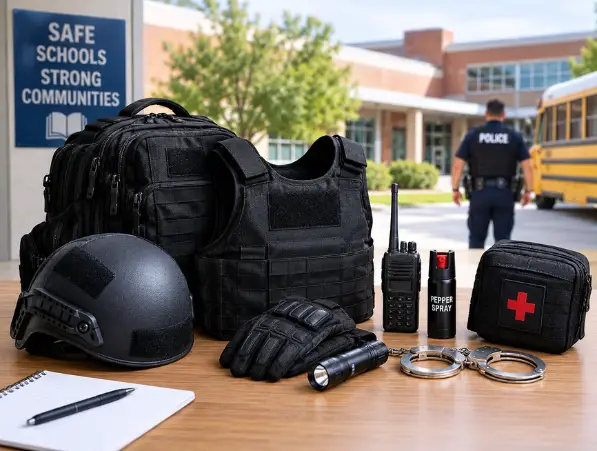
The other consideration is how you look. School officers are supposed to be approachable, and there’s a real tension between that and heavy tactical presence. A lot of districts solve it in two tiers: softer uniform and low-profile carrier for the normal Tuesday, with rifle-rated plates and a go-bag staged in a vehicle or a locked campus closet for the day that isn’t normal.
This is the category school agencies underfund most, and it’s probably the one that changes officer performance the most.
Range work teaches you to shoot. It doesn’t teach you to move through a stairwell, talk on a radio while your heart rate is at 160, or decide in under a second whether to shoot at all. Force-on-force training does that, and it needs marking cartridges plus real protective gear.
The weapon side is straightforward. A conversion kit replaces the bolt in a service weapon so it fires training cartridges instead of live rounds, with no permanent modification. Officers train on the same gun they carry, then swap the bolt back when they’re done. That’s a genuine safety layer, because a converted weapon physically won’t cycle duty ammunition.
Marking rounds are low energy. They are not harmless.
The FX line of simunition protective equipment has three mandatory items: a helmet or a face mask for use with Kevlar helmets, a neck protector, and a groin protector. Arm protectors, a vest and gloves are optional add-ons. The one-piece FX 9002 helmet head protector covers the whole head, gives 180 degree peripheral vision, fits over eyeglasses, and uses a tough nylon shell with two adjustable straps. Simunition policy requires approved FX 9000 series masks along with throat and groin protectors for anyone training with FX marking rounds.
Distance is part of the safety picture too, not an afterthought. General Dynamics recommends minimum stand-off distances of one foot for 9mm and .38 caliber FX marking cartridges, three feet for clipped 5.56mm, and six feet for linked 5.56mm, while noting that agencies also have to follow their own in-service guidelines for authorized force-on-force distances.
One last thing that catches new programs off guard. Paintball and airsoft masks aren’t a substitute. Different round, different energy, tested for something else entirely. If the budget only stretches to gear for half your officers, run the drill with half your officers.
A school campus is honestly close to ideal for this kind of training during summer or a long break. Officers get to rehearse in the actual building, with the actual stairwells and the actual door that sticks. Real hallways plus marking cartridges plus proper protective equipment is about as close to the real thing as anyone can get safely.
Trauma equipment belongs on the same priority tier as armor, not below it. Tourniquet, hemostatic gauze, chest seals, shears, all reachable one-handed, all practiced on within the last year. A tourniquet nobody has trained with is a decoration.
Radios come next, and interoperability is what people forget until it matters. Your officer needs to reach district dispatch, the responding city or county agency, and school administration. If those three run on systems that can’t talk to each other, no amount of equipment spending fixes that on the day it counts.
Then access. Officers need tested, reliable entry to every door on campus, whether that’s a master key set, a credential, or a manual override. Locked-door delay has been a documented factor in past incidents. It’s also one of the cheapest problems on this whole list to solve.
Nobody reading this has unlimited money, so let’s name the constraint. A January 2025 Texas Senate Education Committee report found that more than half of Texas school districts still weren’t meeting the one-armed-officer-per-campus requirement. Even after HB 2 doubled the allotment, districts have been clear that personnel costs eat most of it.
If you’re forced to sequence, here’s a defensible order. Certified armor and trauma kits first, since those address the highest-consequence risk. Communications second. Then less lethal weapons in law enforcement, bought together with the training and policy work that makes them usable. Then force-on-force capability, where a fairly small annual spend produces the biggest change in how officers actually perform.
That order also gives you a clean story for your school board, which counts for something.
A good school police equipment program gets built around the calls that happen every week, not only the one everybody fears. Less than lethal weapons and de-escalation tools sit in the middle. Armor and medical gear form the floor. Training holds the whole thing together.
Lawmen Supply Co. works with district agencies on exactly this kind of build, including Simunition marking cartridges, conversion kits, the full range of simunition protective equipment, and the broader law enforcement tactical gear a school department needs. If you’re standing up a new agency or refreshing an aging inventory, it’s worth working through the entire list in one conversation instead of piecing it together across three budget cycles
Most district agencies build around conducted energy devices and chemical spray, since those cover the situations that actually come up. Impact munitions and launchers are usually staged rather than carried daily. What’s right for you depends on your use-of-force policy, your state law, and how much training time you can protect. If you can’t train on it regularly, it shouldn’t be on the belt.
They need it every single time. Any drill where marking cartridges get fired at a person requires the full mandatory kit: head and face protection, throat protection, groin protection at minimum. Those three exist because the rounds create real impact at close range. Sport gear from paintball or airsoft isn’t an approved stand-in.
Less than a patrol officer, on purpose. Radio, restraints, flashlight, one less lethal option, trauma kit covers the daily reality. Rifle plates, breaching tools and extended medical belong staged in a vehicle or a secured campus location where somebody can get to them fast without wearing them through fifth period.
Safer than a firearm isn’t the same as safe, and your policy should say so in writing. These tools cut the odds of a fatal outcome but can still injure someone, and researchers have raised real questions about conducted energy devices in particular. Agencies working with minors typically add extra guidance covering age, known medical conditions, mental health crisis and supervisor notification. Documentation and training matter as much as the hardware.
Two things. First, the protection levels have new names, so a spec sheet asking for “Level IIIA” should now say HG2. Second, verify certification on NIJ’s public compliant products list rather than trusting a product page, since phrases like “NIJ tested” aren’t regulated. Armor certified to the older 0101.06 standard is still recognized, and NIJ expects to maintain that list through at least the end of 2029, so you can plan replacements on a normal cycle.